
Tiled floor removal
Home » Demolition » Tiled floor removal
Related pages
ABOUT SLOOP CONCURRENT
- Nationwide coverage
- Well insured
- All certifications
- Customer-focused
- Skilled workmanship
- Affordable
- Professional
- Years of experience
Request a quote?
TABLE OF CONTENTS
- Removing a glued tiled floor
- How Sloop Concurrent works
- Removing floor tiles set in cement
- About Sloop Concurrent
- Removing different types of tiled floors
- Want an exact price? Request a quotation
- Tile floor removal costs
- Removing a tiled floor yourself
- What customers say about Sloop Concurrent
- Sloop Concurrent: certifications and insurance
- Have your tiled floor removed by Sloop Concurrent
- Sloop Concurrent: other popular services
- Request a no-obligation quote
Before you can lay a new tiled floor, or have one laid, the old tiled floor must of course be removed. Removing a tiled floor can be very demanding work, but it is manageable with the right tools. Tiles fixed with adhesive are easier to remove than tiles laid in cement. Whether underfloor heating is present also affects the project, as we naturally want to avoid damaging it. You can remove a tiled floor yourself with the right tools, but doing so is not without risk. We therefore strongly recommend leaving tiled floor removal to the specialists at Sloop Concurrent.

Removing a glued tiled floor
Removing a glued tile floor can go fairly smoothly. We start by manually chipping out one or more tiles with a chisel and/or hammer. Once these tiles have been removed, the rest can be lifted easily by inserting a shovel or spade underneath them at an angle. When all the tiles are gone, we sand the adhesive residue off the floor. Removing a glued tile floor is often straightforward, but it is still a heavy, demanding job. We strongly recommend leaving tile floor removal to Sloop Concurrent's professionals.
How Sloop Concurrent works
Before we start work for you, you will naturally want to know how Sloop Concurrent operates. Below is a simple step-by-step guide. We take care of everything from start to finish.


Request a quote
Request a no-obligation quotation and receive a tailored price within 24 hours.
Schedule the project
If you accept the quote, we will schedule the demolition work with you

Carrying out the work
Our team starts work. We only hand over the project when you are 100% satisfied.


Removing floor tiles set in cement
A tiled floor laid in cement is considerably harder to remove than tiles fixed with adhesive. A breaker or demolition hammer with a powerful compressor and various chisels is required. This is heavy equipment, available to hire or buy from a DIY store. When using a breaker or demolition hammer, it is important to let the machine and chisel do the work. The cement floor beneath the tiles is often slightly damaged, which means the screed must be levelled before further work can take place. We strongly recommend leaving the removal of a tiled floor to the experienced specialists at Sloop Concurrent.
About Sloop Concurrent
Sloop Concurrent is a demolition company with nationwide coverage. Our certified demolition teams provide quality, professional demolition work throughout the Netherlands. With several operating bases across the country, we can help you quickly. Our 100 skilled demolition workers are happy to assist, and our efficient way of working allows us to offer demolition services at affordable prices.
Every day, we help private and commercial customers demolish, renovate and repair a range of structures. This includes complete demolition, but our experienced team is equally capable of removing a load-bearing wall or chimney. We confidently describe ourselves as a full-service demolition company.


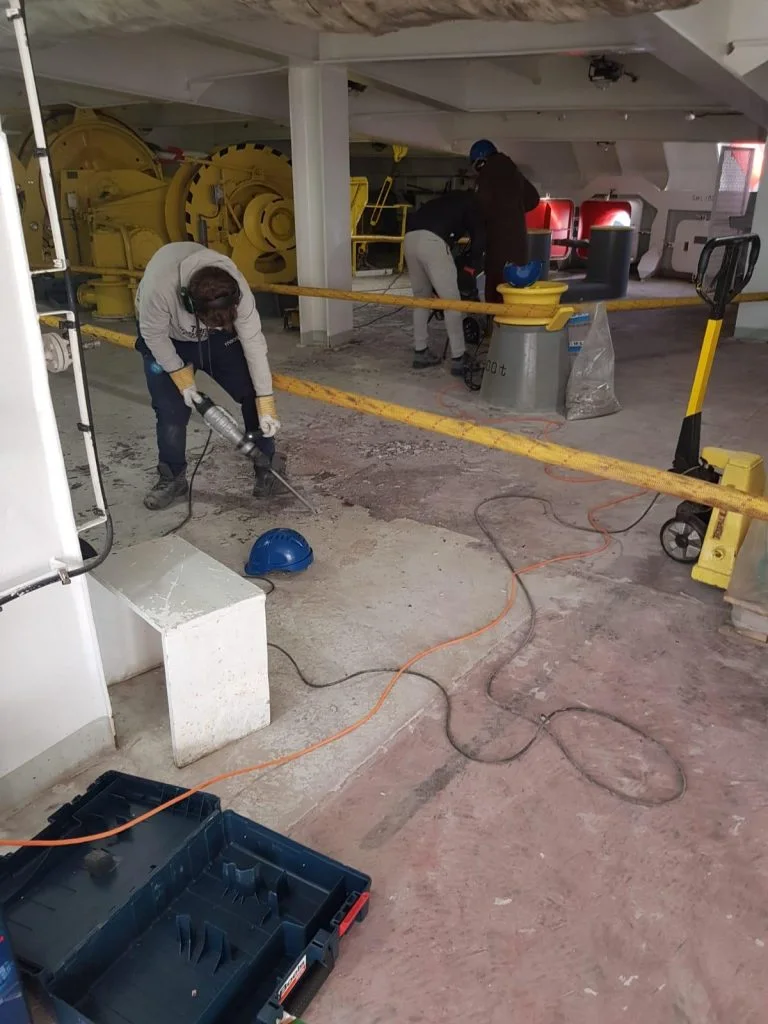
Removing different types of tiled floors
There are many different tiled floors, and each requires a different removal method. Here you will find a brief description of how the tiles are removed for each type of floor.
Removing a PVC floor
Vinyl flooring is often attached to the subfloor with a very strong adhesive, and the planks are rolled after gluing. This makes removing vinyl flooring a highly specialist job, particularly if you want to avoid damaging it. Our specialists remove vinyl flooring with a razor-sharp powered blade, using a floor stripping machine. Extra care is required if underfloor heating is also present.
Removing a vinyl floor
Vinyl flooring is firmly bonded to the subfloor to ensure a long service life. The drawback is that removing it is not straightforward. It is demanding work requiring experience to preserve the subfloor as well as possible. Using the right tools, Sloop Concurrent's specialists remove the vinyl flooring with as little collateral damage as possible.
Removing a timber floor
A timber floor may be floating or glued to the subfloor. The removal method naturally depends on how it was installed. In general, our tradespeople can remove a timber floor relatively quickly, accurately and without damage. If it is glued to the subfloor, the job takes longer than removing a floating floor.
Removing a tiled floor
We use an electric breaker to remove a floor tiled with quarry or ceramic tiles. First, we break out one tile using a hammer or chisel. Once the first tile is removed, we hold the breaker at an angle to remove the remaining tiles. We collect the resulting rubble and can also take it away for you if required.
Want an exact price? Request a quote
Would you like to know what the demolition will cost? Request a quotation with no obligation and receive it by email within 24 hours. Would you prefer us to prepare a quotation on site? That is no problem at all!
Tiled floor removal costs
But what is the average cost of having a tiled floor removed? At Sloop Concurrent, we charge a fixed hourly rate for tile removal, ranging from €40 to €45 per hour. The hourly price depends on the floor area, how the tiles are fixed and how easily they come loose. Would you like us to clear and dispose of the rubble? We can do so for a small additional charge, taking all the heavy work off your hands! Removing tiles from an average living room costs only around €250.
We aim to deliver skilled workmanship at the most affordable price possible. That is why you choose Sloop Concurrent!
Removing a tiled floor yourself
Removing floor tiles yourself is demanding work and is not without risks. With the right tools, it is possible to remove the floor, but we often see inexperience lead to damage to the subfloor. That is unfortunate, as the subfloor must then be repaired before the final floor finish can be laid. Removing a tiled floor yourself may initially seem inexpensive, but it can end up costing more. Always bear this in mind.
Removing a tiled floor involves several steps:
Look for a damaged or cracked floor tile
An already damaged or cracked floor tile provides an ideal starting point for removing the floor. If there is no damaged or cracked tile, start at a grout joint in one of the room's corners.
Place the chisel in the joint
Place the chisel in a joint or crack and strike it with a hammer to remove the grout or widen the crack. Repeat until the tile loosens and can be removed.
All the other tiles can be removed from this point.
Use an electric breaker or rotary hammer
If you remove a large tiled floor yourself, we recommend using an electric breaker or rotary hammer. Bear in mind that this is heavy equipment, and it is important to know how to use it.
Clearing up
Removing tiles produces not only a great deal of rubble but also dust. Collect all the rubble in rubble bags and clean the room thoroughly with a builders' vacuum cleaner. The tile rubble must be taken away; you can take it to your municipality's waste disposal site.
What customers say about Sloop Concurrent
Sloop Concurrent would be nowhere without its customers. This is what our customers have to say about us.


Sloop Concurrent: certifications and insurance
When you ask Sloop Concurrent to carry out your demolition work, you can look forward to a pleasant working relationship. Sloop Concurrent is well insured. We hold CAR insurance, or Construction All Risks insurance, covering material damage arising during the construction or installation of buildings, roads, bridges and systems. We have never had to make a claim on this insurance, but we prefer to be on the safe side.
Sloop Concurrent is also an accredited training company, training the skilled tradespeople of the future. All our demolition workers are trained in-house, and we do not subcontract our work. This is reflected both in the total cost and in the final result.
Asbestos must always be considered when demolishing structures. We therefore hold dNAA certification, which allows us to remove asbestos. We do so safely and responsibly.


Have your tiled floor removed by Sloop Concurrent
Removing a tiled floor is demanding work that requires care. Sloop Concurrent's skilled professionals have many years of experience removing tiled floors and ensure your subfloor remains intact, allowing subsequent floor finishing to proceed smoothly. Would you like more information about the possibilities or a free, no-obligation quote? Complete our contact form on this website, call 06-40125121 or email info@sloop-concurrent.nl.
Sloop Concurrent: other popular services
Demolition is work we carry out with passion and expertise. Below are some of the services our customers choose most often.
Request a no-obligation quote
Would you like more information about our demolition services or a free, no-obligation quotation?
We aim to provide a tailored quotation for your demolition project within 24 hours.
Sloop Concurrent
Olivierstraat 16, 2021BL Haarlem
Sloop Concurrent · Olivierstraat 16, Haarlem
View directions